Walk into Target, Sephora, or Ulta – or spend five minutes scrolling Amazon or watching TikTok, and you’ll find hundreds of skincare products promising brighter, smoother, clearer and younger-looking skin. How are you supposed to know what to buy, who to trust and what is right for you?
1. You’re Buying a Regimen + Guidance, Not Just a Product
One of the biggest differences between professional skincare and shopping the beauty aisle is the person helping you choose it. What are the credentials of the sales associate at Target or Ulta? Do they really know what they are talking about or just repeating what they were taught to say?
At a retailer, you may select a product because it has great reviews, attractive packaging, a trending ingredient or a recommendation from social media or simply the sales associate trying to sell a product. But a five-star serum isn’t necessarily a five-star serum for your skin.
The American Academy of Dermatology recommends choosing skincare based on your individual skin type and concerns. Even proven ingredients such as retinoids aren’t appropriate for everyone and may cause irritation with some skin types. And that’s where professional guidance matters.
Rather than asking: “What’s the best retinol?”
You should be asking: “What does YOUR skin need, at what strength, how often should I be using it, and what should I be using it with?”
More isn’t always better. Stronger isn’t always better. And combining several good products doesn’t automatically create a good skincare regimen.
2. The Ingredients on the Bottle Don’t Tell You the Whole Story
This is one of the biggest differences consumers often don’t realize. A product can advertise retinol, vitamin C, hyaluronic acid or any number of other ingredients prominently on the front of the bottle—but that word alone tells you very little about what you’re actually getting.
How much retinol is actually in the product?
What form of vitamin C is being used?
Does the packaging protect the ingredients from light and air?
How well will your skin tolerate it?
The American Academy of Dermatology notes that OTC products aren’t required to disclose the percentage of ingredients on their labels. Even the ingredient list doesn’t necessarily answer the concentration question. Under FDA cosmetic-labelling rules, ingredients generally appear in descending order of predominance, but ingredients at concentrations of 1% or less can be listed in any order after those present above 1%.
So two products can both advertise “retinol” while being very different formulations.
And concentration isn’t the only issue…
Formulation and stability matter too.
Retinoids can be unstable and may degrade with exposure to factors such as light and heat. One published study evaluated retinoids in commercially available cosmetic products and found degradation ranging from 0% to 80% after six months at room temperature, depending on the product tested. Another study analyzing commercial retinoid products found discrepancies between declared and measured ingredient contents in some of the products tested.
Seeing the same ingredients printed on two bottles does not mean you’re buying equivalent products
- Quality of the ingredients matters
- Quantity of the ingredients matters
- Where and how the ingredients are sourced matters
- Concentration matters
- Form matters
- Formulation matters
- Stability matters
- Packaging matters
- Delivery system matters
And ultimately, whether that formulation is appropriate for your skin matters. Without these answers, you may be wasting your money.
3. Professional Guidance Can Save You from an Expensive Bathroom Cabinet
I’ve seen plenty of bathrooms containing hundreds of dollars’ worth of skincare—and no actual regimen. A cleanser from one brand, a TikTok-famous serum from another, an exfoliating acid someone recommended, a retinol that gets used occasionally because it causes irritation, three moisturizers and six products that sounded great but aren’t actually addressing the person’s primary concern. That gets expensive quickly. A professionally designed skincare regimen doesn’t necessarily mean using ten products. In many cases, I’d rather have someone consistently use four appropriately selected products than own twelve products they’re randomly rotating. The goal isn’t to sell you the most skincare. The goal is to make the products you’re purchasing make sense together.
4. Active Ingredients Need to Work Together
This is the reason I don’t evaluate skincare one bottle at a time. You may have an excellent retinol, an excellent exfoliating acid, an excellent vitamin C serum and an excellent pigmentation product – that doesn’t necessarily mean you should put all four on your face every night. How products are introduced, layered, altered and combined matters, particularly with active ingredients that can irritate. And if your skin becomes chronically irritated because you’re throwing every trending active ingredient at it simultaneously, we haven’t accomplished much. A professional can look at your entire regimen, not simply recommend another product to add to it.
5. Your Home Skincare Should Support Your Professional Treatment
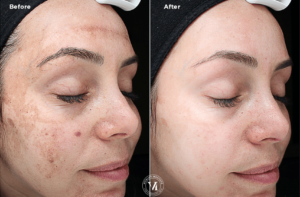
This is particularly important if you’re investing in microneedling, VI Peels or a program designed to correct pigmentation or melasma. What you’re doing at home should support what we’re doing in the treatment room. I want to know which active ingredients you’re using, when you’re using them, and when they need to be temporarily discontinued before or after a treatment. Your professional treatments and your home skincare shouldn’t exist in two separate worlds. They should be working toward the same goal. This is especially important with stubborn conditions, such as pigmentation and melasma. What happens between appointments can be just as important as what happens during them.
6. Where You Purchase Professional Products Matters
There’s another issue with purchasing skincare online: authorized distribution.
Some professional skincare manufacturers specifically restrict where their products are legitimately sold. For example, iS Clinical warns customers that products purchased through unauthorized sellers may be diluted, expired, heat-damaged, or counterfeit. The company maintains an authorized retailer system so consumers can verify where they are buying legitimate products. This is especially relevant with large online marketplaces because the name of the website doesn’t necessarily tell you who the actual seller is.
You should know who you’re buying from and whether the manufacturer authorizes that seller.
When you purchase through a licensed professional who is an authorized provider of the brand, you have much greater confidence about the origin and handling of the product you’re putting on your skin.
7. “Medical Grade” Isn’t a Magic FDA Designation
You often hear professional skincare described as “medical grade,” so why do I choose to carry professional skincare in my practice? Not because putting a bottle on a shelf in my office magically makes it better. I select professional lines because I can evaluate their formulas and ingredients and then choose products based on the individual person, skin concerns, treatments, and goals. I also choose lines whose formulation, quality standards and authorized distribution I trust.
The value isn’t simply what’s in the bottle…
It’s knowing why you’re using it, how you’re using it, what you’re using it with and whether it’s actually working.
What to do with the products you already have?
Sometimes I’ll look at something a patient is already using and say, “Keep it. There’s no reason to replace that.” But if you’re investing significant money trying to correct something—melasma, pigmentation, acne, sun damage, fine lines or texture—I think your home skincare deserves the same intentional approach as your professional treatments.
Sometimes that means replacing several products.
Sometimes it means adding one targeted product.
Sometimes it means removing products you never needed in the first place.
The Bottom Line
Don’t assume that because two bottles both say retinol, vitamin C, peptides or hyaluronic acid you’re purchasing equivalent products.
The ingredients matter
The concentration matters
The quality and form matter
The stability matters
How the products work together matters
And YOUR skin matters most!
When you purchase skincare through a licensed professional, you’re not simply purchasing another bottle. You’re getting professional guidance, a regimen designed around your individual skin and goals, help navigating active ingredients, access to professional products through authorized channels and someone who can adjust the plan as your skin changes.
Because great skincare isn’t about having the most products on your bathroom counter… it’s about having the right ones.
Sources
American Academy of Dermatology Association. Retinoid or Retinol?
U.S. Food & Drug Administration. Cosmetics Labelling Guide. 21 CFR §701.3.
Temova Rakuša Ž, Škufca P, Kristl A, Roškar R. Quality control of retinoids in commercial cosmetic products. Journal of Cosmetic Dermatology. 2021. DOI: 10.1111/jocd.13686.
Temova Rakuša Ž, Škufca P, Kristl A, Roškar R. Retinoid stability and degradation kinetics in commercial cosmetic products. Journal of Cosmetic Dermatology. 2021;20(7):2350–2358. DOI: 10.1111/jocd.13852.
iS Clinical. Authorized Online Retailers — Important Consumer Warning / FAQ About Product Diversion. Innovative Skincare (Science of Skincare, LLC).